
Did You See My Uppercut Coming?


Beyond Punches: What Makes a Skilled Boxer?
Boxing is not simply a contest of strength or courage.
A skilled boxer combines physical conditioning, technical ability, tactical decision-making, perception, and psychology.
Perhaps one of the most important skills is also one of the easiest to overlook:
seeing what is about to happen before it happens.
A punch that appears impossibly fast to a beginner may seem much more predictable to an experienced fighter.
Why?
The answer is partly about how the brain processes visual information.
The Punch You Don’t See
Boxers do not simply see punches.
Their brains continuously interpret movement.
Two useful concepts from psychology help explain this:
Bottom-Up Processing
Bottom-up processing begins with incoming sensory information.
For a boxer, that might include:
- a glove beginning to move,
- a shoulder rotating,
- weight shifting onto one foot,
- a change in distance,
- or the opponent stepping into range.
The visual system detects these physical cues and sends information through the nervous system.
Top-Down Processing
Top-down processing uses previous experience, expectations, knowledge, and pattern recognition to interpret what those cues mean.
A beginner might notice an uppercut only once the glove is already moving upward.
An experienced boxer might recognise the setup earlier:
a change in stance, a shift in weight, a movement of the shoulder, or a familiar attacking pattern.
The difference is not necessarily that experienced boxers have dramatically faster eyes.
They may simply have learned which information matters.
Visual-Motor Response Time
This leads to the idea of visual-motor response time (VMRT).
VMRT describes the time between detecting a visual stimulus and producing an appropriate movement in response.
In boxing, that might look like:
see → recognise → decide → move
Research has found that experienced boxers can demonstrate faster visual-motor responses than less experienced boxers, particularly during boxing-specific movements.
That raises a useful training question:
Can visual-motor response time be trained?
There are several approaches researchers have explored.
Technology-Assisted Training
FitLight
FitLight uses illuminated targets that athletes must respond to quickly.
The idea is simple:
light appears → athlete perceives it → athlete moves
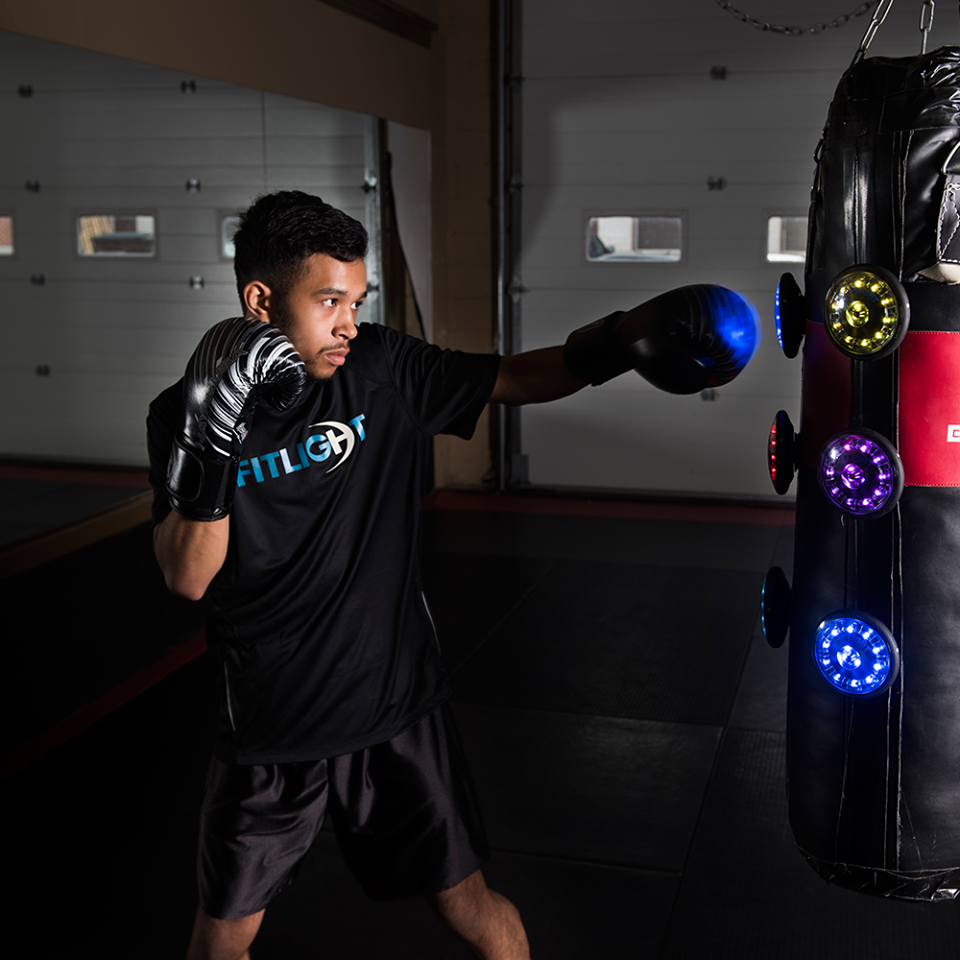
A small study involving elite boxers found improvements in reaction time and punch frequency following a period of FitLight training.
That is interesting, but the evidence remains limited.
Improving performance on a light-based reaction task also does not automatically mean that a boxer will become better at predicting a real opponent.
Real boxing contains much richer information:
- distance,
- rhythm,
- posture,
- deception,
- tactical context,
- fatigue,
- and uncertainty.
NeuroTracker
NeuroTracker trains athletes to track several moving objects simultaneously.
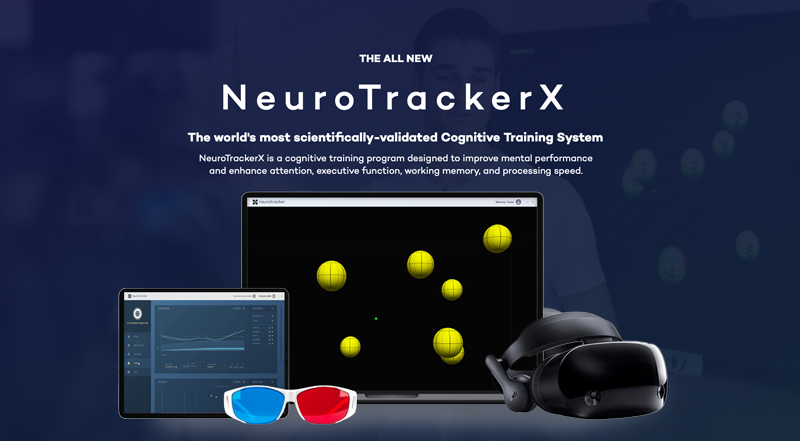
In theory, this could be useful for boxing because fighters constantly monitor multiple sources of information at once.
However, research on transfer is mixed.
Athletes may improve substantially at the NeuroTracker task itself without necessarily showing equivalent improvements in broader cognitive abilities or real sporting performance.
This illustrates an important principle in skill learning:
Getting better at a training task does not necessarily mean getting better at the sport.
Transfer matters.
Exercise-Based Training
Visual-motor performance is not purely visual.
The body still needs to execute the response.
Some research has therefore investigated whether physical training can improve visual reaction performance.
Closed-kinetic-chain exercises such as squats, lunges, and deadlifts have shown promising results in some studies involving boxers.
Other approaches, including post-activation performance enhancement protocols, have produced less convincing results.
The evidence is still limited, and individual factors probably matter:
- training history,
- fatigue,
- strength,
- coordination,
- exercise selection,
- and experience.
Perception Is More Than Reaction Time
Reaction-time drills are appealing because they are easy to measure.
But skilled sport performance may depend on something more interesting:
anticipation.
An expert athlete does not always react faster after an event occurs.
Sometimes they begin responding before the event has fully unfolded because they recognise patterns earlier.
That distinction matters.
A boxer who waits until an uppercut is already travelling toward their chin must respond extremely quickly.
A boxer who recognises the setup half a second earlier has created more time.
Expertise can therefore make someone appear physically faster when part of the advantage is actually perceptual prediction.
Where Should Training Go From Here?
Boxing performance depends on many interacting factors:
- strength,
- conditioning,
- technique,
- tactics,
- recovery,
- psychology,
- perception,
- and decision-making.
Visual-motor response time provides one useful window into this system, but training faster reactions alone is unlikely to explain expertise.
A particularly interesting direction for future research would be safe, situation-specific sparring.
Instead of simply reacting to random lights, athletes could practise recognising realistic boxing cues while controlling contact and intensity.
That may provide a stronger bridge between laboratory-style reaction training and actual performance.
The larger psychological question is fascinating:
Do experts react faster — or do they simply see the future sooner?
Perhaps the best fighters do a little of both.
References
Bendo, A., Bushati, S., & Bushati, M. (2025). Comparison of training methods for improving reaction time and punch frequency at elite boxers. Journal of Physical Education, 36(1). https://doi.org/10.4025/jphyseduc.v36i1.3602
Borysiuk, Z. (2025). Eye-tracking analysis of perceptual-cognitive processes in combat sports: A narrative review. Ido Movement for Culture. Journal of Martial Arts Anthropology. https://doi.org/10.14589/ido.25.3.10
Brinkman, C., Baez, S. E., Quintana, C., Andrews, M. L., Heebner, N. R., Hoch, M. C., & Hoch, J. M. (2020). The reliability of an upper- and lower-extremity visuomotor reaction time task. Journal of Sport Rehabilitation, 30(5), 828–831. https://doi.org/10.1123/jsr.2020-0146
Cid-Calfucura, I., Herrera-Valenzuela, T., Franchini, E., Falco, C., Alvial-Moscoso, J., Pardo-Tamayo, C., Zapata-Huenullán, C., Ojeda-Aravena, A., & Valdés-Badilla, P. (2023). Effects of strength training on physical fitness of Olympic combat sports athletes: A systematic review. International Journal of Environmental Research and Public Health, 20(4), 3516. https://doi.org/10.3390/ijerph20043516
Eastwood, C. (Director). (2004). Million Dollar Baby [Film]. Warner Bros. Pictures.
Fransen, J. (2024). There is no supporting evidence for a far transfer of general perceptual or cognitive training to sports performance. Sports Medicine, 54(11), 2717–2724. https://doi.org/10.1007/s40279-024-02060-x
Ilbak, I., Stojanovic, S., Rydzik, Ł., Ambroży, T., Wąsacz, W., Kasicki, K., Ilbak, Y. E., Jorgic, B. M., & Wieslaw, B. (2024). Examining the effects of post-activation performance enhancement on boxers’ visual reaction time. Ido Movement for Culture. Journal of Martial Arts Anthropology, 24(4). https://doi.org/10.14589/ido.24.4.4
Limballe, A., Kulpa, R., Vu, A., Mavromatis, M., & Bennett, S. J. (2022). Virtual reality boxing: Gaze-contingent manipulation of stimulus properties using blur. Frontiers in Psychology, 13, 902043. https://doi.org/10.3389/fpsyg.2022.902043
Lorenco-Lima, L., Coimbra, D., & Andreato, L. V. (2025). Mental strength, resilience, and grit in combat sports: Comparing practitioners, non-practitioners, and competitors. International Journal of Sport and Exercise Psychology, 1–12. https://doi.org/10.1080/1612197x.2025.2584548
Moen, F., Hrozanova, M., & Stiles, T. (2018). The effects of perceptual-cognitive training with NeuroTracker on executive brain functions among elite athletes. Cogent Psychology, 5(1), 1544105. https://doi.org/10.1080/23311908.2018.1544105
NeuroTracker. (2018, February 15). Professor Faubert introduces the concepts of NeuroTracker. https://www.neurotrackerx.com/post/professor-faubert-introduces-concepts-neurotracker
OpenAI. (2026). AI-generated image of a boxing coach with a quotation from Million Dollar Baby [Image]. ChatGPT.
Tanowsri, R., Chainarong, A., Putthithanasombat, K., Hiruntrakul, A., Philuek, P. P., & Kusump, S. (2026). The effect of NeuroTracker training on attention and decision-making speed in amateur youth boxers. Ido Movement for Culture. Journal of Martial Arts Anthropology. https://doi.org/10.14589/ido.26.2.10
Thomson, E., & Lamb, K. (2016). The technical demands of amateur boxing: Effect of contest outcome, weight and ability. International Journal of Performance Analysis in Sport, 16(1), 203–215. https://doi.org/10.1080/24748668.2016.11868881
Vater, C., Gray, R., & Holcombe, A. O. (2021). A critical systematic review of the NeuroTracker perceptual-cognitive training tool. Psychonomic Bulletin & Review, 28(5), 1458–1483. https://doi.org/10.3758/s13423-021-01892-2
Xiao, Y., Zhong, H., Gao, D., Zhuang, M., Long, Y., Wei, Q., Wang, D., Zhang, P., Zhao, Z., & Chen, C. (2025). The relationship between visual ability assessment and competitive boxing performance in female amateur boxers. Frontiers in Physiology, 16, 1639227. https://doi.org/10.3389/fphys.2025.1639227
Yordanova, Y., Pulev, T., Kirilova, K., Ruteva, M., & Stambolieva, K. (2023). Sport experience and visual motor reaction time of boxers. Journal of Physical Education and Sport, 23. https://www.efsupit.ro/images/stories/may2023/Art146.pdf
Zhang, Z., Piras, A., Chen, C., Kong, B., & Wang, D. (2022). A comparison of perceptual anticipation in combat sports between experts and non-experts: A systematic review and meta-analysis. Frontiers in Psychology, 13, 961960. https://doi.org/10.3389/fpsyg.2022.961960
